The Surreal Reality: How ‘Cartooncore’ is Redefining Compact Living
In the heart of Saint-Ouen, a district just north of Paris known for its mixture of “city grit and creative energy,” a new trend in residential architecture is emerging. As urban dwellers increasingly trade sprawling suburban acreage for the vibrant density of the city, the concept of the “home” is shifting from a standard set of rooms to a curated, imaginative stage for personal expression. Leading this charge is Anthony Authié, an architect at Zyva Studio, who has transformed a 45-square-meter (484 sq. ft.) apartment into what he calls a “cartooncore” sanctuary.
Beyond the Open Plan: Storytelling in 484 Square Feet
For the young couple living here—both of whom work in art and fashion—the goal was not just to fit their lives into a small footprint, but to create an environment that feels like stepping into a dream. Authié’s design philosophy, “cartooncore,” draws inspiration from 90s-era animated films like Space Jam and Who Framed Roger Rabbit, where 2D characters enter the real world.
“I like to play with ideas that mix architecture and imagination,” Authié explains, noting that small spaces like this one “really push you to use your imagination” and force you to think differently. This shift highlights a broader movement in modern interior design: the move away from generic minimalism toward storytelling and the creation of “weird universes” within the everyday.
The Architecture of Play and Function
Reshaping a compact home requires a delicate balance between surreal aesthetics and grown-up functionality. In this three-level apartment, the layout was strategically adjusted to maximize utility without sacrificing the “dramatic” feel of the space:
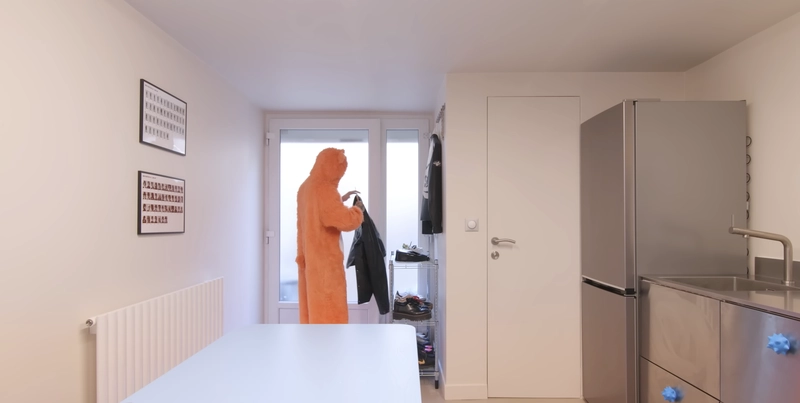
• The Entrance and Kitchen: The ground level is dominated by a stainless steel kitchen that is “super sleek” but punctuated by 3D-printed spiked blue handles. To soften the metallic lines, Authié added a semi-circle backsplash that mimics a sunrise.
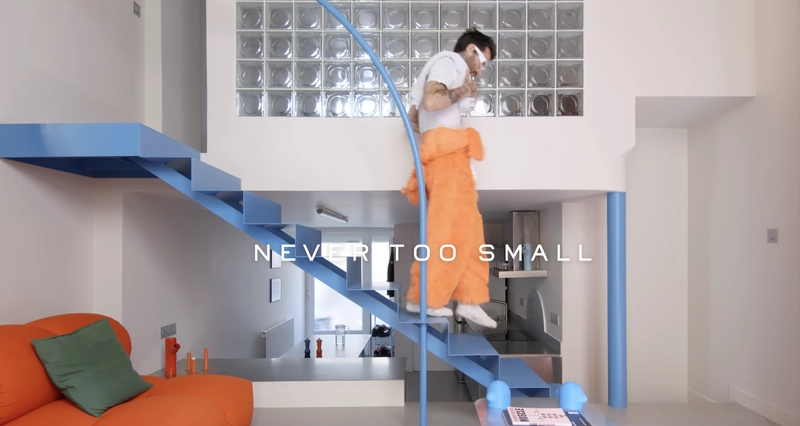
• The Vertical Shift: The staircase was rotated to make the ascent to the living room and bedroom feel more dramatic. Painted in an “intense swimming pool blue,” the metallic stairs are designed to look as if they are floating, with a railing that appears to pierce directly through the steps.
• Space Optimization: In a masterstroke of functional planning, the toilet was moved to the lower floor to free up enough space on the third level for a proper walk-in closet.
Aesthetic Tension: Beauty and Danger
Modern lifestyles are increasingly embracing furniture that doubles as art. Most of the pieces in the Saint-Ouen apartment were made directly in Authié’s studio, featuring chairs shaped like animals and a nightstand adorned with spiked collars.
One of the most striking features is a coffee table from the “spike n’ roses” collection, a tribute to the architect’s grandmother. The design explores the tension between the softness of petals and the threat of thorns, a metaphor for the home itself: a place of comfort that doesn’t shy away from a bit of “danger” and “weirdness”.
Materiality and Immersion
The use of materials in modern compact homes is also evolving to create zonal identity without the need for walls. In this apartment, poured concrete replaces basic tiles on the lower levels, while the bathroom is fully clad in long green tiles to simulate a “tropical greenhouse” vibe. To maintain privacy while allowing light to flow through the split levels, a glass brick wall—designed to look like bubble wrap—serves as a translucent barrier.
As urban living continues to evolve, projects like this suggest that the future of the home is not just about where we sleep, but about how we can inhabit our own imaginations. By prioritizing storytelling and playful design, even the smallest apartments can become expansive, surreal landscapes that reflect the complex identities of their inhabitants.