The New Urban Canvas: How Lifestyle-Driven Design is Resizing the Modern Home
In the heart of Paris’s 18th arrondissement, a quiet revolution is taking place within the walls of former 20th-century artist ateliers. As urban centers become more crowded and property more precious, the traditional concept of a “home” is being dismantled and rebuilt—not in square footage, but in functionality and character.
For many modern dwellers, the dream is no longer a sprawling suburban estate, but a multifunctional space that reflects their passions. This shift is exemplified by a recent project from Petit Jour Architecture, where founders Sophie Berck and Pauline Girardot transformed a bare, 33-square-meter (355 sq. ft.) shell into a bright, flexible residence that offers “all of the comforts of a larger home”.
Designing for the Passionate Resident
The modern home is increasingly defined by the hobbies and work-life balance of its inhabitants. In the case of the Parisian atelier, the client’s passion for ceramics and craftsmanship dictated the layout. Instead of a generic living room, the space was inspired by historical artist workshops, featuring a tiled surface designed specifically as a workspace for ceramics.
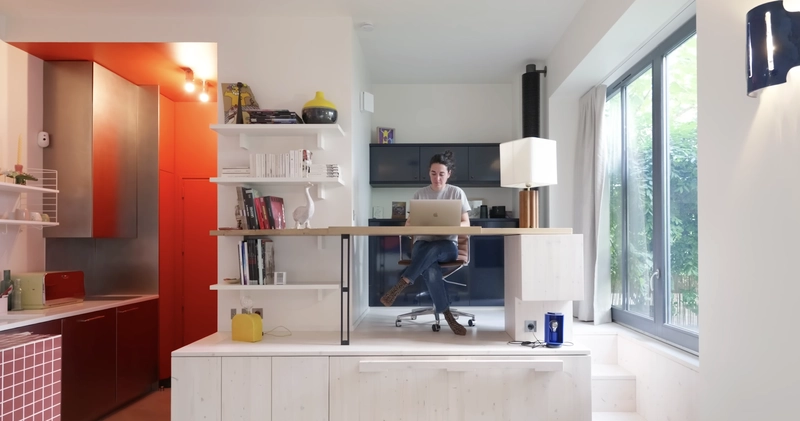
“Anything was possible,” the architects noted when faced with the empty unit, which originally contained only basic utility connections. Their solution was to prioritize light and movement. By placing utility areas—like the slim kitchen and separate toilet—against the walls with the least natural light, they reserved the areas bathed in sun for the office, bedroom, and lounge.
The Art of the “Micro-Move”
Small-space living requires a mastery of optical illusions and mechanical ingenuity. To make a tiny footprint feel expansive, Berck and Girardot utilized several architectural “tricks”:
• Compression and Release: The entrance is painted a bold red-orange with a slightly dropped ceiling. Stepping from this “compressed” space into the main living area makes the rest of the apartment feel significantly larger.
• Reflective Surfaces: The back wall features mirrored closet doors and brushed stainless steel cabinets. These materials bounce light from the garden terrace deep into the apartment, creating a luminous atmosphere.
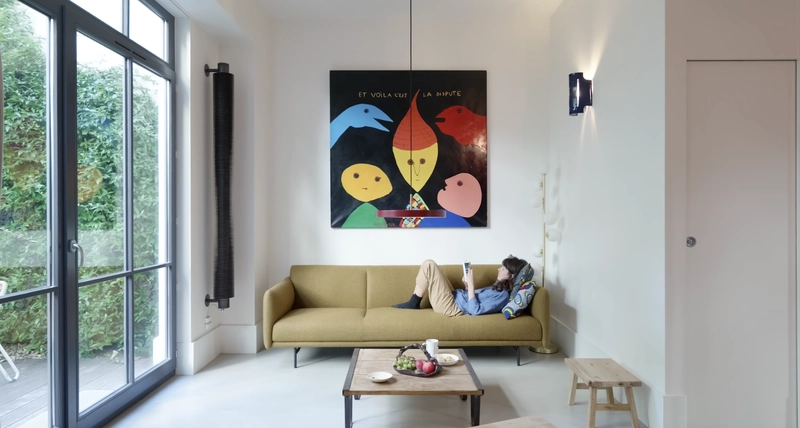
• Elevated Furniture: A mustard-colored sofa sits high off the ground, a design choice that makes the piece appear lighter and the floor space more continuous.
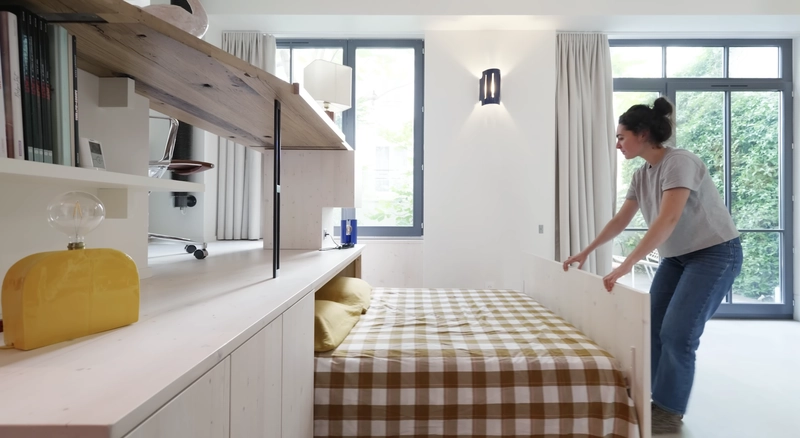
Perhaps the most innovative feature is the sliding bed mechanism. Eschewing the typical “teenager’s room” bunk bed, the architects designed a pine mezzanine that houses an office on top. A full-sized double bed is tucked underneath on rollers and tracks, allowing it to slide out effortlessly when needed and remain hidden during work hours.
Sustainability through Salvage
Modern living is also being reshaped by a desire for durability and history. The Parisian project utilized salvaged oak from an old train wagon for the desk surface, blending industrial history with contemporary utility. Other materials, like the lava stone countertops and varnished concrete floors, were chosen specifically because they are durable, easy to maintain, and honor the “industrial spirit” of the original ateliers.
The Big Picture of Small Living
As cities struggle with affordability, these “tiny footprints” offer a viable path forward. By upgrading historical spaces—like those in Montmartre—designers can preserve the character of a neighborhood while adapting it for contemporary life.
The result is a home that doesn’t feel like a compromise. Through thoughtful design, even a 33-square-meter space can provide a connection to greenery via a private garden and a sense of “quiet quality” that rivals much larger residences.